
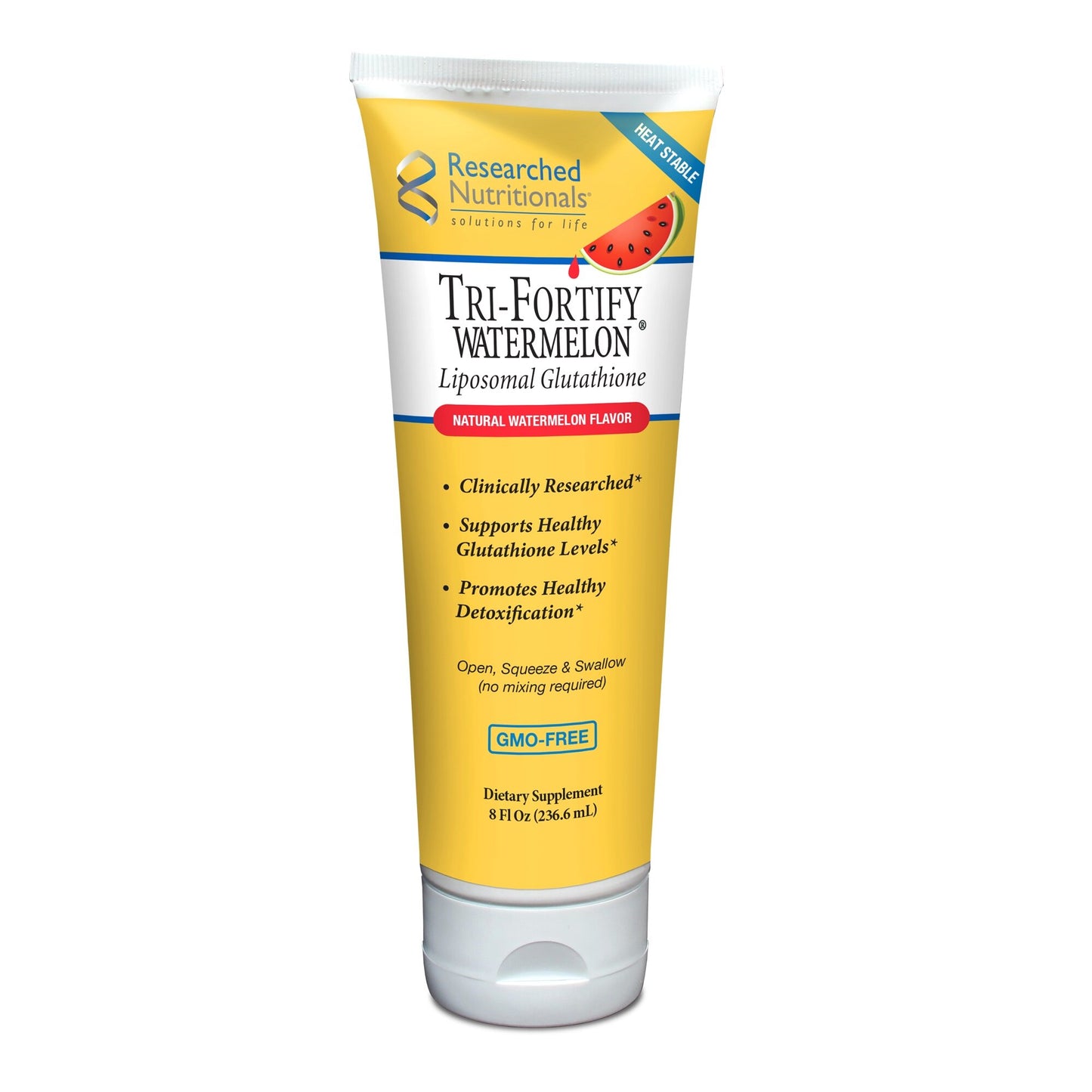
This is a practitioner-grade product. Please log in or register to purchase this product
Tri-Fortify® is a clinically researched liposomal reduced glutathione in a sublingual liquid gel format, providing three synergistic mechanisms of action: antioxidant network support, hepatic biotransformation support, and immune function support. It is the only liposomal glutathione supplement backed by peer-reviewed, published clinical research specifically demonstrating intracellular — not merely plasma — glutathione elevation, and the only liposomal glutathione formulated for full-potency stability at room temperature for a two-year shelf life.
Glutathione — The Master Cellular Antioxidant Glutathione (γ-L-glutamyl-L-cysteinyl-glycine) is a tripeptide synthesised endogenously in every cell from three amino acids — L-glutamic acid, L-cysteine, and L-glycine. It occupies a unique and central position in human cellular biochemistry, functioning simultaneously as a primary antioxidant, an essential cofactor in Phase II hepatic biotransformation, and a critical regulator of immune cell function.
As an antioxidant, glutathione directly neutralises reactive oxygen species within the intracellular environment — including hydrogen peroxide, hydroxyl radicals, and peroxynitrite — and is uniquely capable of recycling oxidised forms of other antioxidants including vitamins C and E, coenzyme Q10, and alpha-lipoic acid back to their reduced (active) states. This network recycling function is the basis for its characterisation as the body's master antioxidant, and is also why Tri-Fortify® has particular clinical synergy when used alongside C-RLA™ (liposomal vitamin C with R-lipoic acid) from the same range.
In hepatic biotransformation, reduced glutathione is the essential substrate for glutathione S-transferase (GST), a family of Phase II enzymes responsible for conjugating electrophilic and lipophilic compounds — including environmental xenobiotics, pharmaceutical metabolites, heavy metals, and endogenous reactive intermediates — rendering them more water-soluble for biliary or urinary excretion. Adequate intracellular glutathione availability is therefore a rate-limiting factor in the efficiency of Phase II conjugation pathways.
For immune function, glutathione is essential for the proliferation and differentiation of T cells, the activation and cytotoxicity of natural killer (NK) cells, and the overall regulation of lymphocyte-mediated immune responses. Glutathione depletion — which occurs under conditions of oxidative stress, chronic infection, environmental toxicant exposure, ageing, and critical illness — is closely associated with impaired immune function across multiple published studies.
The Bioavailability Challenge Oral supplementation with conventional glutathione capsules or tablets is constrained by two fundamental barriers. First, the peptide bond of glutathione renders it susceptible to hydrolysis by gastrointestinal peptidases, meaning a significant proportion is cleaved to its constituent amino acids before systemic absorption. Second, even intact glutathione that reaches the enterocyte is unable to cross the cellular membrane efficiently under normal conditions, as cellular uptake of intact glutathione is limited by membrane transport capacity.
The result is that conventional oral glutathione supplementation typically produces modest increases in plasma glutathione with minimal intracellular delivery — which is precisely where glutathione's antioxidant, biotransformation, and immune functions are exerted.
The Tri-Fortify® Liposomal Solution Tri-Fortify® encapsulates reduced glutathione within phospholipid bilayer liposomes, structurally analogous to cell membranes. These liposomes protect glutathione from gastrointestinal hydrolysis and, via their membrane-mimetic structure, fuse with cellular membranes to deliver glutathione directly into the intracellular compartment. The phospholipids are derived from soy lecithin — using only the lipid fraction (phosphatidylcholine) and not soy protein, the common allergen — and extraction is certified hexane-free.
The formula is administered sublingually: held under the tongue for 30–60 seconds before swallowing, allowing additional direct mucosal absorption through the oral mucosa into the sublingual vasculature, partially bypassing first-pass hepatic metabolism.
Clinical Research — Penn State University Tri-Fortify® is the only liposomal glutathione with peer-reviewed, published clinical evidence demonstrating intracellular glutathione elevation. A human clinical study conducted at Penn State University evaluated changes in intracellular glutathione (not merely plasma glutathione), natural killer cell function, and oxidative stress markers over two weeks of supplementation with Tri-Fortify®. The study demonstrated a 28% increase in intracellular glutathione. The researchers concluded that the elevation of glutathione across blood compartments was accompanied by enhanced immune function and reduced oxidative stress markers.
This distinction — intracellular measurement rather than plasma measurement — is clinically significant. Plasma glutathione levels reflect extracellular pools and do not directly indicate whether glutathione is reaching the intracellular sites where its biological activity is exerted.
Heat Stability — A Unique Formulation Achievement Liposomal glutathione products typically require refrigeration to maintain stability, as glutathione is susceptible to oxidation at ambient temperatures. Researched Nutritionals invested 2 years in developing a proprietary manufacturing process that achieves full-potency stability at room temperature for a 2-year shelf life. An independent third-party stability study confirmed that Tri-Fortify® exceeded label claim potency after six months at 40°C and 75% relative humidity — conditions that represent accelerated shelf-life testing. No other liposomal glutathione product has published data of this standard. The practical implications for patients are improved compliance, portability, and convenience — without the risk of quality degradation associated with a refrigeration-dependent product.
Glycerin serves a dual function in the formulation: it contributes natural sweetness and functions as an antioxidant stabiliser for both glutathione and vitamin C within the preparation. Medium-chain triglycerides (sourced from coconut oil) act as the lipophilic carrier matrix for the liposomal system.
Vitamin C (as ascorbic acid, 50 mg per serving) is included as a complementary antioxidant and glutathione recycling cofactor — ascorbate donates electrons to regenerate reduced glutathione from its oxidised form (GSSG), extending the effective antioxidant cycle.
Why Tri-Fortify®?
Glutathione supplementation is a crowded category with significant variation in product quality, delivery mechanism, and evidence base. Tri-Fortify® distinguishes itself on grounds that are directly clinically relevant:
-
The only liposomal glutathione with published clinical evidence of intracellular elevation. The Penn State study measured where it matters — inside the cell — and demonstrated a statistically significant 28% increase.
-
The only heat-stable liposomal glutathione. Two-year room-temperature stability verified by independent third-party testing at accelerated conditions. No refrigeration required — no compliance barrier, no patient inconvenience, no risk of quality degradation.
-
Sublingual and oral mucosal delivery. The 30–60 second sublingual hold enables direct mucosal absorption in addition to the liposomal gastrointestinal route, maximising systemic delivery.
-
Soy protein-free and hexane-free phospholipids. Uses only the phosphatidylcholine lipid fraction of soy lecithin, not soy protein; hexane extraction is excluded and verified by third-party testing.
-
BPA-free packaging. Verified free of bisphenol A.
-
Minimal, clean excipient profile. Glycerin, MCTs (coconut-derived), soy phospholipids, and natural fruit flavour — no artificial sweeteners, colours, or preservatives.
Supplement Facts
Serving Size: 1 teaspoon (5 mL) Servings Per Container: ~48 (8 fl oz / 236.6 mL tube)
| Ingredient |
Amount Per Serving |
| Reduced Glutathione |
450 mg |
| Vitamin C (as Ascorbic Acid) |
50 mg |
Other Ingredients: Glycerin, medium-chain triglycerides (from coconut oil), phospholipids (from soy lecithin), natural flavour.
Contains: Ingredients partially derived from soy and tree nuts (coconut).
Directions for Use
As a dietary supplement, gently squeeze the tube to fill 1 teaspoon (5 mL). Hold under the tongue for 30–60 seconds, then swallow. Additional servings may be taken as directed by your healthcare practitioner. Shake or mix gently before use. Occasional separation does not affect potency. Store on its side for best results.
No refrigeration required. Store in a cool, dry place away from direct sunlight.
Allergen Information
Manufactured without milk, eggs, fish, crustacean shellfish, peanuts, wheat, or gluten. Produced in a facility that may process ingredients containing these allergens.
Contains ingredients partially derived from soy (phosphatidylcholine lipid fraction only — soy protein-free) and tree nuts (coconut-derived MCTs).
Suitable for vegetarians and vegans. GMO-free. Hexane-free. BPA-free packaging.
Cautions & Contraindications
- Glutathione supplementation may theoretically influence the metabolism of certain chemotherapeutic agents via Phase II biotransformation pathways. Patients undergoing chemotherapy or other oncological treatments should consult their oncologist before use.
- Occasional separation of the preparation may occur; this does not indicate product degradation or loss of potency.
- If pregnant or lactating, consult your healthcare practitioner before use.
- Keep out of reach of children.
Practitioner Note
Tri-Fortify® is the most rigorously evidenced oral glutathione product in the current practitioner market, and the heat stability and sublingual delivery format meaningfully improve upon the limitations that have historically made oral glutathione supplementation a contested clinical choice. Key considerations:
Clinical indications where this product is most strongly indicated: Patients presenting with elevated oxidative stress burden — whether from chronic infection, environmental toxicant exposure, post-viral syndromes, heavy metal accumulation, mycotoxin exposure, chronic inflammatory states, or hepatic biotransformation insufficiency. Also valuable as foundational antioxidant support in patients who are poor NAC responders or who have compromised endogenous glutathione synthesis capacity (older patients, those with significant cysteine depletion, or patients with chronic illness placing high demand on glutathione reserves).
Complementary pairing with C-RLA™: The metabolic logic for co-administering Tri-Fortify® with C-RLA™ is well-founded. Ascorbate regenerates oxidised glutathione (GSSG) back to its reduced form (GSH), and R-lipoic acid independently regenerates both ascorbate and glutathione. The three-way recycling network — glutathione, vitamin C, and R-lipoic acid — provides comprehensive intracellular antioxidant coverage across both aqueous and lipophilic cellular compartments. Researched Nutritionals positions these products explicitly as a clinical pairing, which is biochemically sound.
Intracellular vs plasma measurement — communicating evidence to patients: The clinical study outcome of a 28% increase in intracellular glutathione is significant from a mechanistic standpoint and differentiates Tri-Fortify® from products that only demonstrate plasma elevation. When communicating this to patients, it is worth emphasising that glutathione primarily functions within the cell — its antioxidant, Phase II biotransformation, and immune-regulatory activities all depend on an adequate intracellular concentration.
Soy-sensitive patients: The product uses only the phospholipid fraction of soy lecithin (phosphatidylcholine), not soy protein — the protein fraction is responsible for the vast majority of clinically relevant soy-allergic reactions. In practice, most patients with soy sensitivity tolerate this product well. However, for patients with documented severe soy allergy or confirmed IgE-mediated soy reactivity, a soy-free liposomal alternative should be considered.
Dosing flexibility: At 450 mg per 5 mL serving, the standard dose is once daily. In clinical protocols for significant oxidative stress, heavy metal clearance, or post-chemotherapy antioxidant support, twice-daily dosing (900 mg/day) is commonly used. The product tolerates dose escalation without concern for accumulation or toxicity.