
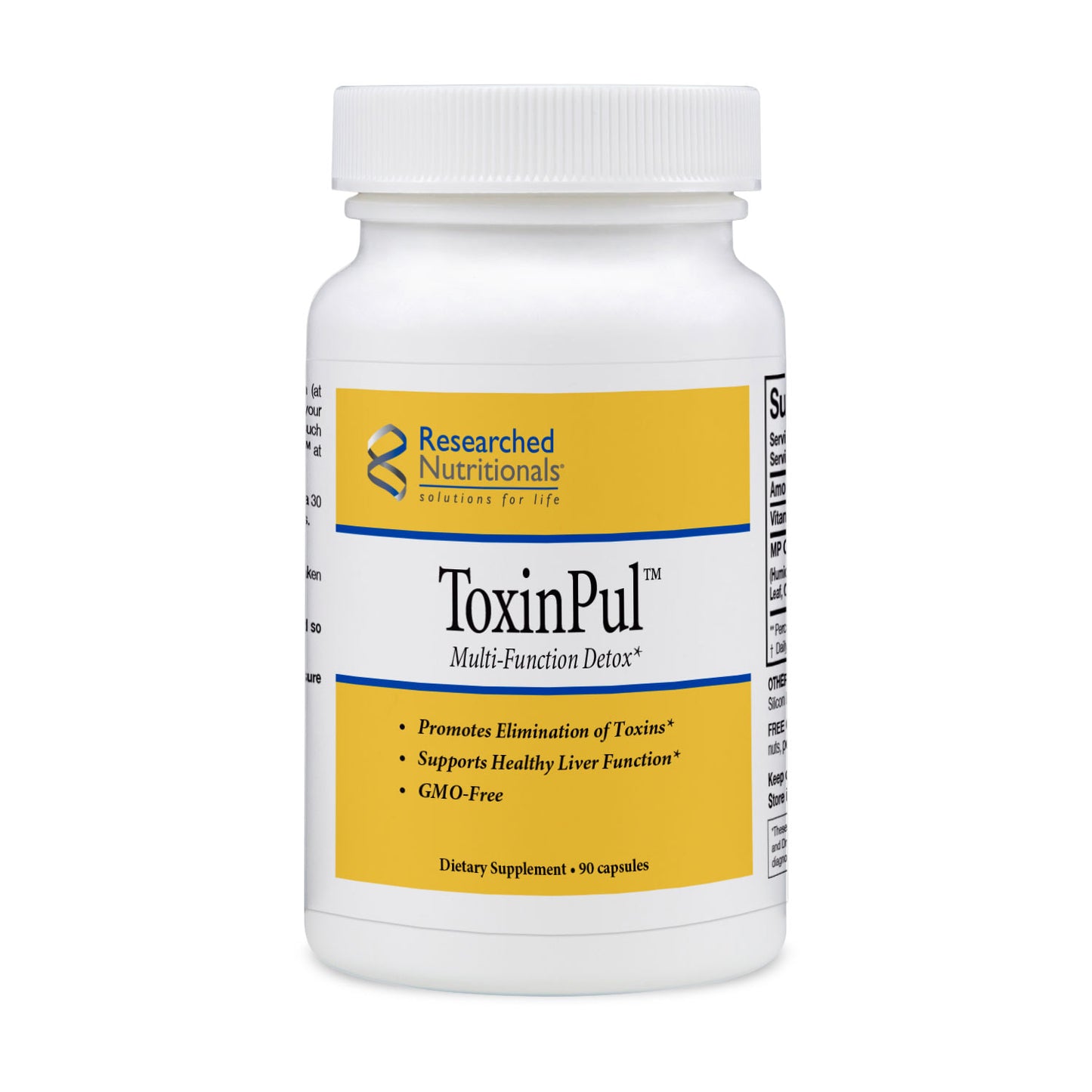
ToxinPul™ is a practitioner-formulated, multi-mechanism formula combining GI tract and systemic toxin-binding agents with hepatobiliary and renal support herbs, antioxidant nutrients, and a premium bioavailability-enhanced quercetin. The formula is structured around two complementary proprietary blends — ToxPul™ Complex (binders and mobilisers) and LivCleanse™ Complex (organ support and antioxidant protection) — to provide simultaneous support for environmental xenobiotic binding, elimination pathway function, and tissue antioxidant defence.
Important co-supplementation requirement: The binders in ToxPul™ Complex are non-selective in their binding activity and will reduce the gastrointestinal absorption of essential dietary minerals as well as environmental xenobiotics when taken concurrently. It is essential that patients supplement with a comprehensive multi-mineral product — such as Researched Nutritionals Core Minerals™ — taken at the opposite end of the day from ToxinPul™ to maintain adequate mineral status during use.
Understanding Binder Categories — GI Tract vs Systemic
Binding agents for environmental xenobiotics fall into two functional categories: those that act exclusively within the gastrointestinal tract, adsorbing compounds in the gut lumen before they are absorbed; and those that act systemically, entering the bloodstream and tissues to chelate and mobilise xenobiotics at the cellular level for subsequent elimination via biliary or urinary routes. Most commercially available binder products contain only GI tract-active binders, which limits their effectiveness to compounds still present within the intestinal lumen at the time of ingestion. ToxinPul™ uniquely combines both categories within a single formulation.
ToxPul™ Complex (660 mg per serving)
Fulvic Acid is a low molecular weight organic acid produced during the microbial decomposition of organic matter. Unlike high molecular weight humic acid (which acts primarily in the gut lumen), fulvic acid has sufficiently small molecular dimensions to cross epithelial membranes and enter the systemic circulation. This systemic distribution enables fulvic acid to chelate heavy metals, organochlorine compounds, and other lipophilic xenobiotics from tissue compartments — including intracellular environments — for transport to the liver and kidneys for subsequent biliary and urinary excretion. Fulvic acid thus provides the formula's primary systemic binder activity, addressing the deeper tissue xenobiotic compartment that GI-only binders cannot access.
PureBind™ Humic Acid is a premium-grade humic acid standardised to 70% humic acid concentration — more than twice the 30% concentration typically found in standard commercially available humic substances. Humic acid is the high molecular weight fraction of humic substances, acting primarily within the GI tract by adsorbing environmental xenobiotics (including heavy metals, chlorinated compounds, and other environmental contaminants) onto its complex organic matrix before they can be absorbed through the intestinal epithelium. The higher 70% concentration provides substantially greater adsorptive capacity per gram compared to standard-grade humic acid products.
Organic Cilantro Leaf (Coriandrum sativum) has both traditional and emerging research support for its role in mobilising heavy metal deposits from tissues into circulation for subsequent chelation and elimination. Its primary mechanism involves binding to heavy metals (particularly mercury and lead) within cells and tissues, loosening them from their intracellular deposits and facilitating their transfer to chelating agents for excretion. Critically, cilantro is most safely and effectively used when co-formulated with concurrent binding agents — a point that distinguishes ToxinPul™ from standalone cilantro or chlorella protocols. By including cilantro within the same formula as its co-binders, the product ensures that mobilised metals are captured by the binders within the same dosing cycle.
Silica (silicon dioxide in a form suitable for GI binding activity) contributes to the adsorptive capacity for mycotoxins and certain lipophilic environmental compounds within the gut lumen. Silica is particularly studied for its binding affinity for aflatoxins and other fungal mycotoxins at gastrointestinal level, providing complementary binding coverage to the humic acid for the mycotoxin category of environmental exposures.
Chlorella (Broken Cell) Powder (Chlorella vulgaris) is specified as broken cell wall chlorella, which is essential for bioavailability — intact cell wall chlorella passes largely undigested through the GI tract. The broken cell wall specification ensures that chlorella's bioactive constituents, including its dense, fibrous cell wall (which has demonstrated heavy-metal adsorptive capacity), chlorophyll, and glycoproteins, are accessible for their physiological functions. Chlorella has been studied extensively for its binding affinity for lead, mercury, cadmium, and dioxins within the GI tract, functioning as a GI-level binder complementary to PureBind™ humic acid.
LivCleanse™ Complex (1,200 mg per serving)
Taurine is a conditionally essential sulphur-containing amino acid and one of the most abundant free amino acids in the human body. Its central role in the LivCleanse™ Complex stems from its function as the primary bile acid taurine conjugation substrate in the liver. Taurine-conjugated bile acids (taurocholate, taurochenodeoxycholate) are essential for healthy bile flow and for the biliary excretion of fat-soluble xenobiotic conjugates from Phase II hepatic biotransformation. When liver taurine availability is reduced — as it can be during periods of elevated hepatic xenobiotic load — bile flow and the biliary clearance of lipophilic toxin conjugates may be compromised. Taurine also provides direct cytoprotective effects in hepatocytes during periods of increased oxidative stress, and supports mitochondrial function via its role in mitochondrial tRNA modification.
Dandelion Root (Taraxacum officinale) is a classical choleretic and cholagogue herb with a well-established record of traditional use and evidence-informed practice for hepatobiliary support. Choleretic activity (stimulation of bile production) and cholagogue activity (stimulation of bile release from the gallbladder) together increase the flow of bile through the biliary tree, supporting the clearance of Phase II conjugates — glucuronidated, sulphated, glutathione-conjugated, and taurine-conjugated xenobiotics — into the intestinal lumen for faecal excretion. Dandelion root also provides inulin-type fructooligosaccharides that support gut microbiome ecology during detoxification protocols, and exerts mild diuretic activity supporting renal clearance of water-soluble xenobiotic metabolites.
Quercefit® (Stabilised Quercetin) is the patented quercetin-phosphatidylcholine phytosome from Indena S.p.A. (Italy), delivering quercetin at approximately 20-fold greater oral bioavailability compared to standard unformulated quercetin. In the detoxification context, Quercefit® provides three synergistic mechanisms:
First, potent antioxidant activity during the oxidative stress that accompanies Phase I cytochrome P450 biotransformation of environmental xenobiotics — Phase I metabolism generates reactive electrophilic intermediates and reactive oxygen species that can cause collateral hepatocyte damage if not adequately scavenged.
Second, modulation of NF-κB-mediated pro-inflammatory signalling. When lipophilic xenobiotics and heavy metals are mobilised from tissue stores during a detoxification protocol, their transit through circulation can transiently trigger inflammatory signalling cascades in sensitive individuals. Quercetin's well-documented NF-κB inhibitory activity helps maintain a balanced immune and inflammatory response during this process.
Third, Nrf2 pathway activation — quercetin upregulates Nrf2-dependent antioxidant response elements, including the genes encoding for glutathione synthesis enzymes (glutamate-cysteine ligase, glutathione synthetase), haem oxygenase-1, and NAD(P)H:quinone oxidoreductase. This Nrf2 activation supports the endogenous antioxidant and Phase II enzyme capacity that is placed under increased demand during active xenobiotic clearance.
Vitamin C (as Ascorbic Acid, 100 mg) provides direct antioxidant protection during the detoxification process, scavenging reactive oxygen species generated during Phase I xenobiotic metabolism, and regenerating reduced (active) glutathione from its oxidised form (GSSG) — extending the effective antioxidant capacity of the hepatic glutathione pool.
Why ToxinPul™?
In the growing category of binder and detoxification support products, ToxinPul™ differentiates on several clinically significant grounds:
-
Combines GI tract and systemic binders. Most commercial binder products (activated charcoal, bentonite clay, modified citrus pectin) act exclusively within the gut lumen. Fulvic acid's systemic distribution provides access to the tissue compartment — the principal repository of accumulated lipophilic xenobiotics — that GI-only binders cannot address.
-
PureBind™ humic acid at 70% concentration. More than double the humic acid content of standard humic substances, providing greater adsorptive capacity per serving for GI-level binding.
-
Cilantro co-formulated with binders. Cilantro as a standalone mobiliser carries the theoretical risk of redistributing mobilised metals to alternate tissue sites before they are cleared. ToxinPul™ addresses this by including cilantro within the same formula as its binding agents, so mobilisation and capture occur within the same dosing cycle — a significant safety and efficacy advantage over separate cilantro or cilantro-tincture protocols.
-
Quercefit® — the highest bioavailability quercetin available. As with HistaQuel® in your range, the phytosome delivery system provides systemic quercetin plasma levels from a manageable oral dose.
-
LivCleanse™ Complex addresses the elimination bottleneck. Binding toxins for GI or systemic clearance is clinically useful only if the hepatobiliary and renal excretion pathways are functioning adequately. Taurine and dandelion root specifically support the bile flow mechanisms required for biliary toxin-conjugate clearance — addressing the downstream elimination bottleneck that binder-only formulas neglect.
-
Complementary pairing with Core Minerals™ and Tri-Fortify®. Researched Nutritionals explicitly positions ToxinPul™ alongside Core Minerals™ (for mineral replenishment during binder use) and Tri-Fortify® (liposomal glutathione, to support Phase II glutathione conjugation and hepatic antioxidant capacity during active xenobiotic clearance). These three products form a coherent, mechanistically integrated clinical protocol.
Supplement Facts
Serving Size: 3 Capsules (taken once daily) Servings Per Container: 30
| Ingredient |
Amount Per Serving |
| Vitamin C (as Ascorbic Acid) |
100 mg |
| ToxPul™ Complex |
660 mg |
| Fulvic Acid |
|
| PureBind™ Humic Acid (70% humic acid) |
|
| Organic Cilantro Leaf (Coriandrum sativum) |
|
| Silica |
|
| Chlorella (Broken Cell) Powder (Chlorella vulgaris) |
|
| LivCleanse™ Complex |
1,200 mg |
| Taurine |
|
| Dandelion Root (Taraxacum officinale) |
|
| Quercefit® (Stabilised Quercetin) |
|
| Vitamin C (as Ascorbic Acid) |
|
Individual constituent doses within each proprietary blend are not disclosed.
Other Ingredients: Silicon dioxide, hypromellose (vegetable capsule).
Quercefit® is a registered trademark of Indena S.p.A., Italy.
Directions for Use
Take 3 capsules once daily on an empty stomach — at least two hours after eating or one hour before eating — or as directed by your healthcare practitioner.
Essential: Take a comprehensive multi-mineral supplement (such as Core Minerals™) at the opposite time of day — morning if ToxinPul™ is taken in the evening, or evening if ToxinPul™ is taken in the morning. Do not take mineral supplements within four hours of ToxinPul™.
Allergen Information
Manufactured without milk, eggs, fish, crustacean shellfish, tree nuts, peanuts, wheat, soy, or gluten. Produced in a facility that may process ingredients containing these allergens. Suitable for vegetarians. GMO-free.
Cautions & Contraindications
-
Must be co-supplemented with a multi-mineral product (e.g., Core Minerals™) taken at the opposite time of day. The non-selective binders in ToxPul™ Complex will bind and reduce the absorption of essential dietary minerals (calcium, magnesium, zinc, selenium, etc.) if taken concurrently with food or mineral supplements. Failure to co-supplement with minerals during extended ToxinPul™ use may result in progressive mineral depletion.
- Quercefit® (quercetin) may inhibit CYP3A4 and CYP2C9 hepatic enzyme activity. Caution is advised in patients taking medications metabolised via these pathways — including certain statins, immunosuppressants, warfarin, calcium channel blockers, and benzodiazepines. Consult your healthcare practitioner before use if taking any prescription medications.
- Patients with known sensitivity to Asteraceae (daisy) family plants should exercise caution — dandelion (Taraxacum officinale) is a member of this plant family. Discontinue if allergic reactions occur.
- Chlorella contains iodine; patients with iodine sensitivity or autoimmune thyroid disease should consult their healthcare practitioner.
- Patients with active gallbladder obstruction or bile duct obstruction should not use this product without medical supervision — dandelion root and taurine stimulate bile flow.
- Not recommended during pregnancy or lactation without professional supervision.
- Keep out of reach of children.
- Store in a cool, dry place away from direct sunlight.
Practitioner Notes — Stephen Roigard
ToxinPul™ is one of the more clinically sophisticated binder products in the current practitioner market, and its multi-mechanism design addresses genuine limitations in the conventional single-binder approach. Key clinical considerations for your practice:
Patient selection and protocol framing: This product is most clinically indicated for patients with confirmed or clinically suspected elevated environmental xenobiotic burden — including those with documented heavy metal excess on hair tissue mineral analysis or provoked urinary metal testing; patients with mycotoxin illness or mould-exposure history; those with chronic pesticide/herbicide exposure (agricultural workers, gardeners, orchard workers — a relevant population in the Canterbury/South Island agricultural context); and patients undertaking comprehensive Phase I/II hepatic biotransformation support protocols.
The cilantro mobilisation principle — managing the "retoxification" concern: In naturopathic and integrative practice, the phenomenon of symptom exacerbation during initial xenobiotic mobilisation (colloquially termed "die-off" or "retoxification") is a clinical reality for some patients, particularly those with high tissue burdens of lipophilic xenobiotics. The inclusion of binders in the same formula as cilantro substantially mitigates but does not entirely eliminate this risk. For highly sensitive patients or those with a history of significant reactions to detoxification protocols, beginning with one capsule daily and titrating up over one to two weeks is a prudent approach. Ensuring adequate bile flow (dandelion root + taurine in the LivCleanse™ Complex) and adequate hydration during protocol use supports smooth transit of mobilised compounds through the elimination pathways.
The mineral depletion risk — a non-negotiable clinical consideration: The co-supplementation requirement with Core Minerals™ is not merely a Researched Nutritionals cross-selling recommendation — it reflects a genuine and significant physiological risk in patients taking non-selective binders long-term without mineral replenishment. The same electronegativity and cation-binding properties that make humic acid, fulvic acid, and chlorella effective binders for xenobiotics also cause them to bind essential minerals. Extended use (four weeks or more) without concurrent mineral supplementation at a separated time of day will progressively deplete body stores of magnesium, zinc, selenium, calcium, and other minerals. This is especially important in your NZ patient population, where dietary mineral intake is frequently marginal. The timing separation of at least four hours between ToxinPul™ and Core Minerals™ is the practical minimum to avoid competitive binding.
Combination with Tri-Fortify®: The mechanistically coherent clinical protocol for this product is ToxinPul™ (evening) + Core Minerals™ (morning) + Tri-Fortify® (morning, away from ToxinPul™). The glutathione provided by Tri-Fortify® directly supports Phase II glutathione-S-transferase conjugation of the xenobiotics being mobilised by ToxinPul™, and the Nrf2-activating effects of Quercefit® in ToxinPul™ upregulate endogenous glutathione synthesis — creating a synergistic circuit between the two products.
Quercefit® CYP interactions in the detoxification context: The CYP3A4 inhibitory potential of quercetin at clinical doses is particularly relevant in the detoxification context, because several Phase I biotransformation reactions for environmental xenobiotics are CYP3A4-mediated. While quercetin's CYP inhibition is generally considered a beneficial effect in the context of antioxidant protection (slowing the generation of reactive Phase I intermediates), it can become problematic in patients on pharmaceutical drugs with narrow therapeutic indices. A full medication review is essential before initiating ToxinPul™.
Duration and cycling: ToxinPul™ is typically used according to defined protocols rather than continuously. Common clinical approaches include 30-day cycles with assessment and mineral status review, or continuous use for 3 to 6 months in patients with a significant chronic xenobiotic burden, with quarterly mineral testing. Longer-term use is clinically reasonable provided Core Minerals™ co-supplementation is maintained and monitored.