
Skip to product information
1 of 2

Researched Nutritionals

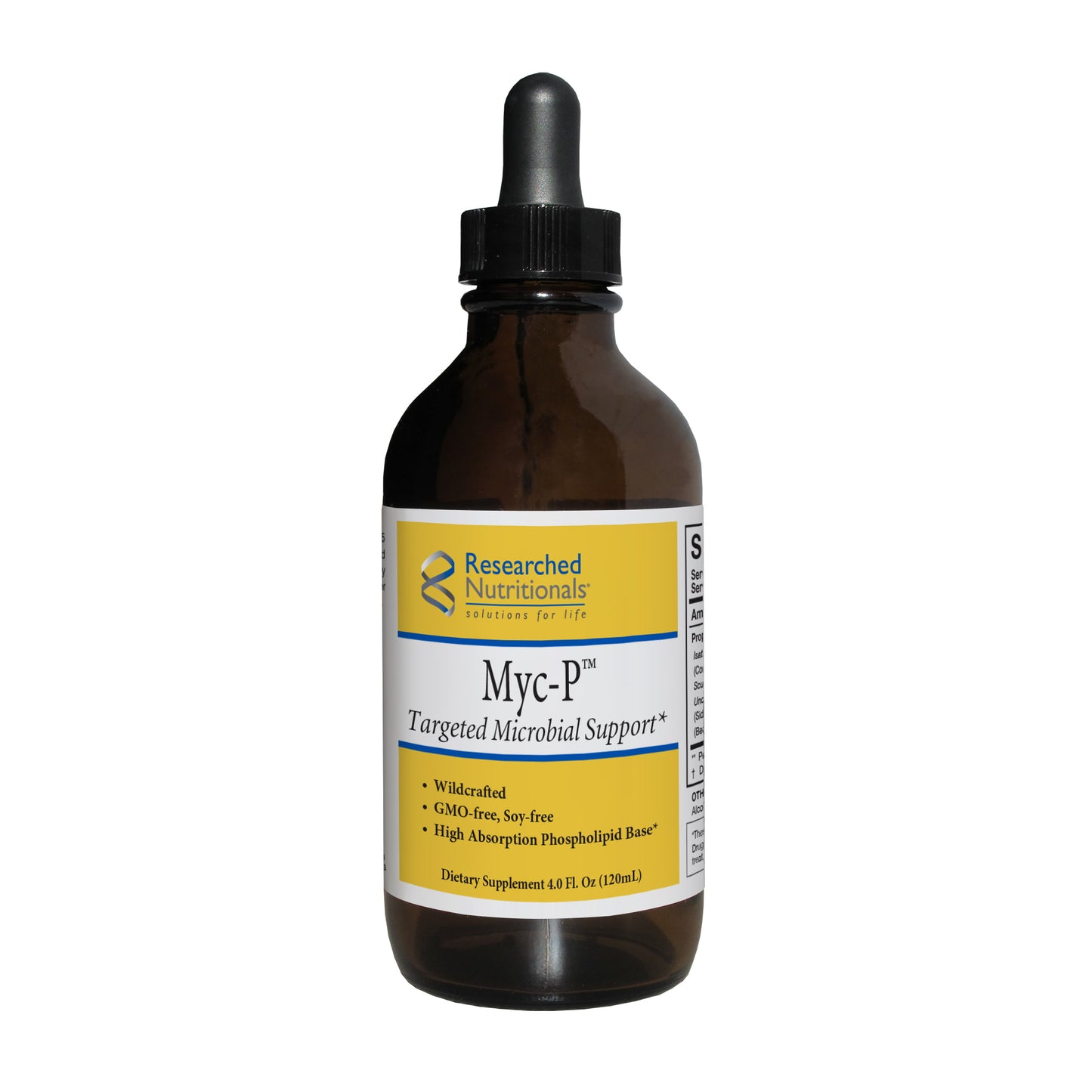
Myc-P

Myc-P

Regular price $145.00 NZD
Regular price Sale price $145.00 NZD
Sale Sold out
Tax included. Shipping calculated at checkout.

This is a practitioner-grade product. Please log in or register to purchase this product

If you already have an account, you can login here:

Myc-P™ is a practitioner-formulated liquid herbal tincture combining eight synergistic botanicals with a non-soy sunflower phospholipid delivery base to support healthy microbial balance, immune surveillance function, and multi-organ resilience. The formula is designed to be used within supervised practitioner protocols and may be layered with other herbal tinctures or clinical interventions as clinically appropriate.

Phospholipid Delivery — Enhanced Tissue Absorption Non-GMO sunflower-derived phospholipids (principally phosphatidylcholine) form an integral component of the tincture base. The phospholipid matrix surrounds the herbal constituents, enabling the preparation to interact with biological membranes and facilitating enhanced absorption and tissue distribution of the active alkaloids, flavonoids, and terpene compounds beyond what standard aqueous or alcohol tinctures achieve on their own. This is a distinguishing formulation feature of the Researched Nutritionals microbial balance range.

Organic Cane Alcohol Extraction (20%) Organic cane alcohol is the preferred solvent for extracting bioactive alkaloids from roots and barks — the primary botanical materials in this formula. Alkaloids are generally poorly soluble in water alone; alcohol extraction at the 20% concentration used in Myc-P™ provides sufficient solvating capacity for complete alkaloid extraction while remaining palatable and compatible with the phospholipid delivery base. The alcohol is derived from organic cane sugar and is gluten-free.

The Proprietary Herbal Blend (280 mg per full serving)

Isatis root (Isatis indigotica) — Known in Traditional Chinese Medicine as Ban Lan Gen — has a long history of use as an immune-supportive herb. Its primary bioactive constituents include indirubin, indigo, and isatidine alkaloids, alongside polysaccharides. Modern research supports its role in modulating innate immune function, influencing NF-κB-mediated cytokine signalling, and supporting healthy mucosal immune barriers.

Cordyceps (Cordyceps sinensis) — A tonifying fungal adaptogen from Traditional Chinese Medicine with a substantial modern research base. Cordyceps contains cordycepin (3'-deoxyadenosine), beta-glucan polysaccharides, and nucleoside compounds associated with immune modulation, mitochondrial bioenergetics support, and adaptogenic HPA axis regulation. Its dual immune-modulating and energy-supporting properties provide complementary support within a microbial balance protocol.

Houttuynia (Houttuynia cordata) — Known as Yu Xing Cao in TCM and dokudami in Japanese kampo medicine, houttuynia has an extensive traditional use record for supporting the body's natural defences, particularly at mucosal surfaces. Its bioactive constituents include quercetin, rutin, isoquercitrin, and houttuynia alkaloids. Research has focused on its flavonoid content and its roles in supporting healthy immune signalling and antioxidant defence in mucosal tissue environments.

Chinese Skullcap root (Scutellaria baicalensis) — One of the most extensively researched herbs in the TCM materia medica, Chinese Skullcap (Huang Qin) is the primary source of baicalin and baicalein — two flavonoids with well-characterised anti-inflammatory, antioxidant, and immune-modulatory properties. Baicalin inhibits NF-κB and STAT3 signalling, modulates Th1/Th2 cytokine balance, and provides significant flavonoid-based antioxidant coverage. Chinese Skullcap is considered one of the foundational herbs in integrative herbal immune support protocols.

Cat's Claw bark (Uncaria tomentosa) — Cat's Claw (Uña de Gato) is a Peruvian rainforest vine whose inner bark contains a complex of oxindole and pentacyclic alkaloids — particularly mitraphylline, isomitraphylline, and rynchophylline — alongside quinovic acid glycosides and tannins. These alkaloids are associated with immune modulation, supporting healthy macrophage, T-cell, and NK cell activity. Cat's Claw has been evaluated in human clinical studies for its immune-supportive and anti-inflammatory properties, and is one of the most clinically referenced herbs in integrative medicine protocols for systemic immune balance.

Sida acuta leaf — A herbaceous plant in the Malvaceae family with traditional use across Ayurvedic, African, and Caribbean botanical medicine systems. Sida acuta contains vasicine (peganine) and vasicinone alkaloids, alongside flavonoids and saponins. Research has focused on its alkaloid content and associated properties, which support healthy immune function and respiratory mucosal defence. Its inclusion in this formula contributes complementary alkaloid diversity to the formula's overall mechanistic profile.

Bearberry (Arctostaphylos uva-ursi) — Bearberry leaf contains arbutin (a hydroquinone glycoside), ursolic acid, tannins, and flavonoids. Bearberry has a well-established traditional use record for supporting healthy urinary tract ecology and provides urinary system support within the multi-organ support design of this formula. Organ support — particularly urinary and hepatic clearance capacity — is an integral consideration in protocols designed to maintain comprehensive systemic balance during periods of immune challenge.

Stillingia root (Stillingia sylvatica) — A native North American herbal plant from the Euphorbiaceae family with a historical use record in eclectic botanical medicine as an alterative and lymphagogue. Stillingia contains diterpenoids and other constituents associated with supporting lymphatic clearance and healthy immune tissue drainage. Its inclusion reflects the formula's attention to lymphatic and connective tissue compartment support alongside direct immune modulation.


Why Myc-P™?

  • Eight-herb synergistic blend. The formula is not a single-herb intervention — the eight botanicals address immune modulation through complementary and overlapping mechanisms, including NF-κB modulation, support for macrophages and T cells, mucosal immune defence, adaptogenic HPA balance, and support for lymphatic/urinary system clearance.
  • Phospholipid delivery — a distinguishing formulation feature. Standard herbal tinctures are distributed primarily in the aqueous compartment. The sunflower phospholipid delivery system in Myc-P™ facilitates tissue-level distribution of the herbal constituents beyond what conventional water/alcohol tinctures achieve.
  • Organic cane alcohol extraction — optimal for alkaloid-rich botanicals. The 20% alcohol base is the appropriate solvent strength for extracting the oxindole alkaloids of Cat's Claw, the isoquinoline alkaloids of Houttuynia, and the alkaloid constituents of Sida acuta and Stillingia root — which are poorly extracted by water alone.
  • Titratable dosing. The drop-based liquid format enables precise, gradual dose titration, which is particularly valuable for sensitive patients requiring slow protocol initiation. This level of dosing flexibility is not achievable with capsule-format products.
  • Practitioner-channel positioning. Myc-P™ is sold exclusively through the healthcare professional channel and is not intended for self-selection or unsupervised consumer use.

Ingredients

Proprietary Herbal Blend: 280 mg (per full serving of approximately 40 drops)

Isatis indigotica (Isatis root), Cordyceps sinensis (Cordyceps), Houttuynia cordata (Houttuynia), Scutellaria baicalensis (Chinese Skullcap root), Uncaria tomentosa (Cat's Claw bark), Sida acuta (Sida Acuta leaf), Arctostaphylos uva-ursi (Bearberry), Stillingia sylvatica (Stillingia root)

Individual herb doses within the proprietary blend are not disclosed.

Other Ingredients: Distilled water, organic cane alcohol (20%), non-GMO sunflower phospholipids.


Directions for Use

Take away from meals — at least 45 minutes before eating or 2 hours after eating. Add drops to 30–90 mL (1–3 oz) of water before drinking.

Starting Dose: Days 1–3: 3–5 drops in water, morning and evening. Days 4 onwards: Increase by 3–5 drops every other day, in both morning and evening doses.

Full Dose: 40 drops (approximately half a standard dropper) twice daily — typically reached after 10–14 days of gradual titration.

Sensitive Patients: Begin with 1 drop once daily in water and increase very gradually as the body adjusts.

Always follow the dosing guidance of your healthcare practitioner.


Allergen Information

Manufactured without milk, eggs, fish, crustacean shellfish, tree nuts, peanuts, wheat, soy, corn, or gluten. Vegan. GMO-free. Contains 20% organic cane alcohol (gluten-free).


Cautions & Contraindications

  • Do not use during pregnancy or lactation.
  • Contains 20% organic cane alcohol. Not appropriate for patients with alcohol sensitivity, those in recovery from alcohol use disorder, or those taking medications with known alcohol interactions (including disulfiram, metronidazole, or tinidazole).
  • Cat's Claw (Uncaria tomentosa) may have immune-stimulatory properties — caution is advised in patients taking immunosuppressant medications, including cyclosporine, tacrolimus, mycophenolate, or corticosteroids. Consult your healthcare practitioner before use.
  • Cat's Claw and Chinese Skullcap may influence CYP3A4 enzyme activity and potentially interact with medications metabolised by this pathway. Consult your healthcare practitioner if taking any prescription medications.
  • Cat's Claw may have anticoagulant properties; caution with blood-thinning medications including warfarin and antiplatelet agents.
  • Arctostaphylos uva-ursi (Bearberry) contains arbutin, which metabolises to hydroquinone in alkaline urine. Prolonged or high-dose use is not recommended. Not recommended for extended use without practitioner supervision.
  • Stillingia sylvatica may cause gastrointestinal irritation at higher doses; if nausea occurs, take 15–30 minutes after a light carbohydrate snack.
  • Some patients initiating herbal immune support protocols experience transient reactions during dose escalation — reduce dose or slow the titration schedule if this occurs, and consult your healthcare practitioner.
  • Keep out of reach of children.
  • Store tightly closed in a cool, dry place away from direct sunlight.

Practitioner Notes — Stephen Roigard

Myc-P™ is the most clinically specific product in the Researched Nutritionals range on your website, and the one that requires the greatest care in both patient communication and public-facing copy. The following notes are for your clinical reference only — not for public display.

Clinical positioning: Myc-P™ is formulated and clinically used primarily within integrative medicine protocols for chronic complex infections — specifically including tick-borne illnesses (Borrelia/Lyme disease), Bartonella, and Mycoplasma, as well as other atypical or persistent microbial challenges that have not resolved with or without conventional antimicrobial therapy. In your practice as a naturopath and herbalist, this context is clinically appropriate for patient management discussions and protocol design. It is not, however, appropriate for NZ public-facing product copy — see the regulatory note below.

The "Herxheimer" reaction — patient preparation: The Researched Nutritionals product page explicitly acknowledges that some patients experience a Jarisch-Herxheimer-like reaction when initiating this formula, consistent with its mechanism of action in the context of infection-associated protocols. This is a critical point for patient counselling: advise patients to begin at the lowest possible dose (1 drop once daily for sensitive patients), support the detoxification and clearance pathways concurrently with Tri-Fortify® (liposomal glutathione) and ToxinPul™, and not to interpret initial reactivity as a reason to abandon the protocol. The recommended Researched Nutritionals pre-treatment protocol is Tri-Fortify® for at least three days before commencing Myc-P™, with ToxinPul™ to be used concurrently for binder support.

The "layering" protocol principle: Myc-P™ is designed to be used within a layered protocol — either alongside other Researched Nutritionals herbal tinctures (BLt™, Crypto-Plus™, Elim-A-Cand™) or as an adjunct to prescription antimicrobial therapy, where clinically indicated. The FAQ on the Researched Nutritionals site explicitly addresses concurrent use with antibiotics. In your NZ practice, this is a legitimate clinical consideration; in public-facing copy it should not appear.

Key herb clinical rationale for your reference:

Cat's Claw: The most clinically referenced herb in this formula within the integrative Lyme/tick-borne illness literature (particularly Buhner and the Cowden protocols). Pentacyclic oxindole alkaloids (POAs) support NK cell and macrophage activity; quinovic acid glycosides contribute to anti-inflammatory activity. The TOA (tetracyclic oxindole alkaloid)-free specification is preferred by some practitioners but is not specified in this formula — Researched Nutritionals uses a full-spectrum Cat's Claw extract.

Chinese Skullcap: Baicalin and baicalein have been specifically researched in the context of Borrelia biology, including studies by Eva Sapi's group and others examining baicalein's effects on both motile and persister forms. This is the most directly researched herb in this formula for the primary clinical application.

Houttuynia: Featured in both the Buhner Lyme protocol and several mycoplasma-focused integrative protocols. Its flavonoid content (quercetin, rutin) provides complementary immune modulation alongside the alkaloid-rich herbs.

Sida acuta: Specifically included in Stephen Buhner's tick-borne disease protocols for its vasicine content and associated biofilm-modulating properties in some preliminary research.

For clinical use in patients on prescription antibiotics: Myc-P™ can generally be taken concurrently with antibiotics — Researched Nutritionals and integrative prescribers routinely use this combination. If there is concern, a two-hour separation from antibiotics provides a practical safety margin.

View full details