
Skip to product information
1 of 1

Precision Point

P88 Dietary Antigen Test

P88 Dietary Antigen Test

Regular price $783.00 NZD
Regular price Sale price $783.00 NZD
Sale Sold out
Tax included. Shipping calculated at checkout.
Type

Sample Required: Urine | Test Type: Toxicity | Sample: View sample report

IMPORTANT: Not all food sensitivity testing is created equal. A number of laboratories and practitioners offer assessments based on hair samples, electrodermal (Vega) testing, or applied kinesiology. There is currently no high-quality scientific evidence supporting the accuracy or reliability of these methods, and it is these poorly-evidenced approaches that have given food sensitivity testing an unfairly mixed reputation.

Skin prick testing sits in a different category. It is a genuinely useful tool for identifying immediate, IgE-mediated food allergy (intolerance) — the rapid-onset reactions the immune system mounts within minutes. What it is not designed to detect is delayed, IgG-mediated food reactions (sensitivity), which is the focus of this test. Relying on a skin prick test to assess sensitivity measures the wrong pathway, and is unreliable for this purpose.

The P88 is a very different proposition: a laboratory-based serum analysis performed by a CLIA-licensed, COLA-accredited laboratory using validated ELISA methodology, measuring multiple defined immune markers — including the IgG subclasses central to delayed sensitivity — against each food tested.


A comprehensive, multi-pathway assessment of how your immune system responds to 88 common foods and dietary compounds.

If you experience symptoms that seem to come and go with no obvious cause — bloating, changeable bowel habits, skin flare-ups, congestion, headaches, joint discomfort, low energy or disrupted sleep — food may be one piece of the picture. The challenge is that immune reactions to food are complex, and a single food can trigger the immune system through multiple pathways. A test that measures only one antibody type can miss the reactions that matter most.

The P88 Dietary Antigen Test is one of the most thorough dietary antigen panels available. Rather than looking at a single marker, it measures multiple immune responses to each of 88 foods and dietary components, giving a far more complete map of your individual reactivity.

What the P88 measures

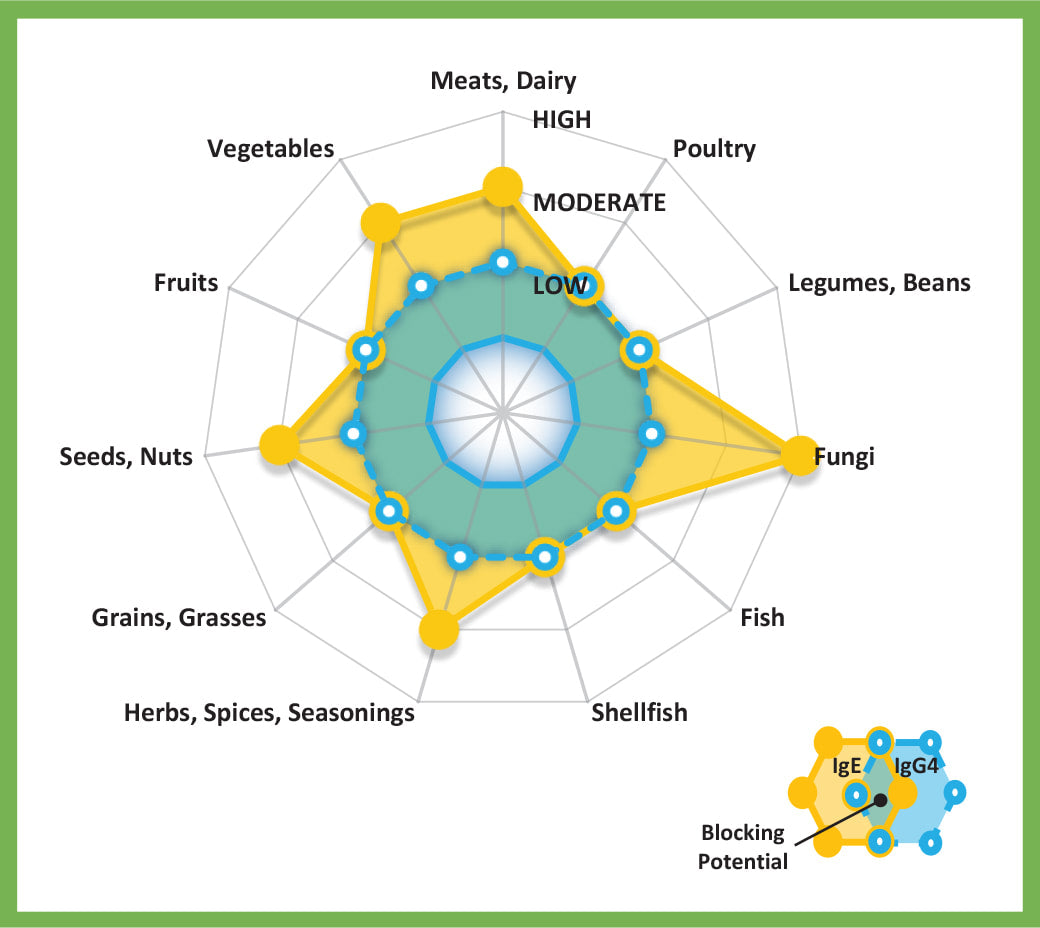
For every item on the panel, the test assesses several distinct immune markers together:

IgE — the pathway associated with classic, immediate allergy-type responses.

IgG subclasses (IgG1–3) and IgG4 reported separately — an important distinction. IgG1–3 are the subclasses capable of binding complement and are associated with inflammatory reactivity, while IgG4 is regarded as a marker of immune tolerance. Many panels combine all four into a single "total IgG" figure, which conflates reactivity and tolerance into a single number and can be misleading. The P88 keeps them separate so the result is meaningful.

IgA subtypes (IgA1 and IgA2) — offering an additional layer of insight into serum immune reactivity.

Complement markers (C3d/C4d) — the P88 was the first dietary antigen test to report immune complexes containing C3d. Complement activation is one of the most potent amplifiers of an inflammatory response, and can intensify an antibody reaction many-fold. Panels that overlook complement may miss the reactions that are most relevant to how you feel.

Assessing these pathways side by side is what sets the P88 apart. Because you may react to a food through one pathway rather than another, testing several at once helps ensure that meaningful reactions are not overlooked.

Optional zonulin marker

The P88 can be extended with zonulin, a well-researched marker associated with intestinal permeability (the integrity of the gut lining). Adding zonulin allows your practitioner to view your food-immune reactivity alongside an indication of intestinal barrier integrity in the one assessment.

The 88 foods and compounds tested

The panel covers a broad, everyday cross-section of the diet, including dairy (cow's and goat's milk, casein), egg (albumin and yolk), gluten-containing and gluten-free grains (whole wheat, gluten, barley, rye, oat, rice, corn), legumes, tree nuts and peanut, a wide range of fruits and vegetables, seafood and shellfish, meats and poultry, herbs, spices and beverages (coffee, tea, cacao), along with yeasts and moulds (brewer's yeast, Candida, Aspergillus mix). The 88 items were selected for their prevalence in the diet and their potential to provoke an immune response, making the panel both practical and clinically relevant.

How results are used

The interpretive report is designed to be clear and practical. It groups reactions by food family, indicates the degree and pathway of each reaction, and includes both more-restrictive and less-restrictive elimination options. This detail helps avoid unnecessarily broad dietary restriction — you and your practitioner can focus on the foods your immune system is genuinely responding to, rather than removing foods needlessly. Results are intended to inform a personalised dietary strategy, developed with your practitioner as part of your wider health plan.

Who this test may suit

You may wish to consider the P88 if you suspect food is playing a role in how you feel, if you want an in-depth food-immune assessment that examines both allergy-type (IgE) and delayed reactivity, if you have a family history of food sensitivities, or if you would value working from objective data when refining your diet.

About the laboratory

The P88 is processed by Precision Point Diagnostics, a CLIA-licensed and COLA-accredited laboratory in Georgia, USA, founded by Dr Cheryl Burdette, ND. Testing uses an indirect ELISA (enzyme-linked immunosorbent assay) to provide reliable, reproducible, semi-quantitative measurements, with the added capability to detect immune complexes containing complement.

This test is available for order through Stephen Roigard Integrative Health and is best undertaken with practitioner support, so your results can be interpreted accurately and translated into clear, actionable steps.


Functional Medical Tests – Costs, Terms & Timeframes

The P88 is available as a self-collection fingerstick kit or as a serum panel. The serum version requires a venous blood sample drawn by a phlebotomist or at a collection facility, after which the prepared sample is returned using the provided prepaid, temperature-controlled packaging. Both formats incur only minimal administrative costs and include full instructions.

Kits are dispatched to one of our New Zealand distributors — FxMed or Nutriscript — who consolidate and forward samples via weekly shipments to accredited laboratories in the United States or Australia.

The standard turnaround time for results is 3–5 weeks from the date of sample submission. If you have not received your results within 5 weeks, please contact us so we can follow up on your behalf.

Please note: Occasional delays may occur due to customs clearance, international courier disruptions, or laboratory backlogs. These are outside our control, but we will assist in tracking and resolving any extended delays.

Once results are available, we receive them directly from the distributor and forward them to you on the same day. Laboratory reports typically include detailed interpretations, reference ranges, and explanatory notes.

We strongly recommend booking a follow-up consultation — either online or in person — to contextualise your results within your broader health strategy. This ensures accurate interpretation and integration into your personalised care plan.

Consultation fees are additional to the cost of the test kit.


View full details