
This is a practitioner-grade product. Please log in or register to purchase this product
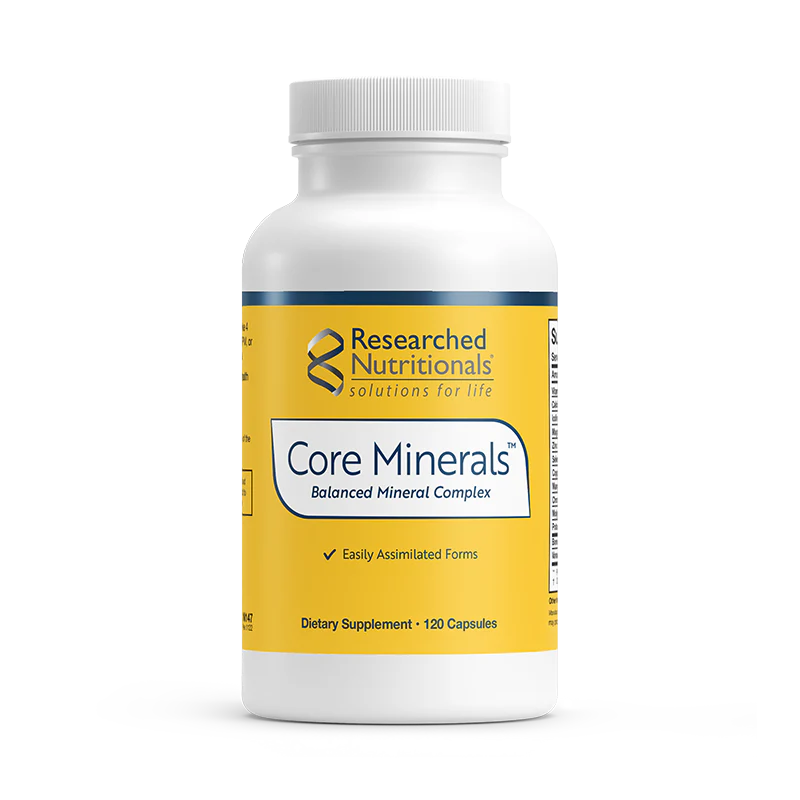
Core Minerals™ is a comprehensive, iron-free multi-mineral complex providing thirteen essential and trace minerals plus vitamin D3, with every mineral supplied in a highly bioavailable chelated or organic form. Designed as a foundational daily mineral supplement, the formula addresses the most clinically relevant gaps in modern dietary mineral intake and provides structured support for skeletal integrity, neuromuscular function, metabolic enzyme activity, immune regulation, and thyroid function.
The formula is split into a twice-daily dosing schedule — two capsules with the morning meal and two with the evening meal — a deliberate design choice that maximises mineral absorption by avoiding competitive transport inhibition when multiple minerals are presented simultaneously in large amounts.
Calcium (300 mg) — as Calcium Citrate and Calcium Malate Calcium is provided in a dual-salt combination of citrate and malate. Both forms are organic salts that dissociate readily in the gastrointestinal tract without requiring gastric acid for solubilisation — making them substantially more bioavailable than calcium carbonate, which depends on adequate gastric acid for dissolution. This is particularly relevant for patients with hypochlorhydria, those taking proton pump inhibitors, or older adults with declining gastric acid output. The combination of citrate and malate provides complementary absorption profiles for consistent uptake across the digestive tract. Calcium is essential for skeletal mineralisation, neuromuscular excitability, cardiac conduction, blood coagulation, and intracellular signalling.
Magnesium (300 mg) — as Magnesium Glycinate Magnesium glycinate — the chelate of magnesium with glycine — is widely regarded as the optimal magnesium form for supplementation. The glycine chelate is absorbed via amino acid transport pathways rather than competing with other minerals for divalent cation transporters, resulting in superior bioavailability and markedly reduced gastrointestinal side effects compared to inorganic magnesium salts (oxide, sulfate, chloride). Magnesium is a cofactor for over 300 enzymatic reactions, including ATP synthesis, DNA replication and repair, protein synthesis, and the regulation of calcium channels. Magnesium deficiency is among the most prevalent micronutrient insufficiencies in Western populations, and is common in NZ, where dietary magnesium is often marginal.
Zinc (15 mg) — as Zinc Picolinate Zinc picolinate is a chelate of zinc with picolinic acid, a naturally occurring metabolite of tryptophan. Published research has demonstrated superior gastrointestinal absorption of zinc picolinate compared to zinc citrate and zinc gluconate forms. Zinc is essential for the structure and activity of over 300 metalloenzymes, immune cell development and function (particularly T-cell and NK cell activity), wound healing, protein synthesis, and the maintenance of taste and olfactory acuity.
Selenium (100 mcg) — as Selenium Citrate Selenium citrate provides selenium in an organically complexed form that is substantially more bioavailable than inorganic selenate or selenite. Selenium is the essential trace element constituent of the selenoprotein family, including glutathione peroxidase (antioxidant defence), thioredoxin reductase (redox regulation), and the iodothyronine deiodinase enzymes responsible for peripheral T4-to-T3 thyroid hormone conversion. Adequate selenium status is particularly relevant for thyroid function, immune regulation, and reproductive health.
Iodine (150 mcg) — from Kelp Iodine is supplied from kelp (Ascophyllum nodosum or equivalent), providing iodine in its naturally occurring marine plant matrix. Iodine is the essential raw material for thyroid hormone biosynthesis — both thyroxine (T4) and triiodothyronine (T3) are iodinated tyrosine-based compounds synthesised in the thyroid follicular cells. Adequate iodine intake is essential for normal thyroid gland function, metabolic regulation, and neurological development. At 150 mcg per daily serving, this formula meets the estimated average requirement for adults.
Copper (2 mg) — as Copper Glycinate Copper glycinate is an amino acid chelate providing copper in a bioavailable form without the gastrointestinal irritation associated with inorganic copper salts. The inclusion of copper at 2 mg alongside zinc at 15 mg (a zinc:copper ratio of 7.5:1) is a deliberate formulation decision that reflects the known antagonism between these minerals — zinc supplementation without concurrent copper can progressively impair copper status, leading to anaemia, immune compromise, and connective tissue defects. Copper is required for cytochrome c oxidase (mitochondrial energy production), ceruloplasmin (iron metabolism), superoxide dismutase (antioxidant defence), and collagen cross-linking.
Manganese (2 mg) — as Manganese Glycinate Manganese glycinate provides a well-tolerated amino acid chelate of manganese. Manganese is a cofactor for manganese superoxide dismutase (MnSOD), the primary mitochondrial antioxidant enzyme, as well as for arginase, pyruvate carboxylase, and glycosyltransferases involved in proteoglycan synthesis — making it particularly relevant for cartilage and connective tissue integrity.
Chromium (200 mcg) — as Chromium Polynicotinate Chromium polynicotinate (also known as chromium nicotinate) provides trivalent chromium complexed with niacin, a natural chromium form considered more bioavailable than chromium chloride or picolinate. Chromium potentiates insulin receptor signalling by facilitating the action of chromodulin (low-molecular-weight chromium-binding substance), supporting healthy insulin sensitivity and normal carbohydrate and lipid metabolism.
Molybdenum (100 mcg) — as Sodium Molybdate. Molybdenum is an essential trace element and cofactor for three molybdoenzymes: sulphite oxidase (sulphur amino acid metabolism and sulphite detoxification), xanthine oxidase (purine metabolism and uric acid production), and aldehyde oxidase (aldehyde catabolism). Sodium molybdate is the most widely used supplemental form and provides reliable systemic molybdenum availability.
Potassium (99 mg) — as Potassium Citrate Potassium citrate provides potassium in a well-tolerated, alkalinising organic acid form. Potassium is the principal intracellular cation, essential for maintaining cellular electrochemical gradients, nerve impulse transmission, cardiac rhythm, and smooth and skeletal muscle contractility. Dietary potassium intake is frequently below optimal in Western populations consuming high-processed-food diets. Note: NZ regulatory limits cap supplemental potassium at 99 mg per daily dose in most natural health product formats.
Boron (2 mg) — as Boron Picolinate Boron picolinate provides boron in a picolinic acid chelate form for enhanced bioavailability. Boron is an emerging essential trace element with demonstrated roles in calcium and magnesium metabolism, bone mineralisation, vitamin D3 utilisation, and the modulation of steroid hormone activity. Supplemental boron has been associated with improved retention of calcium and magnesium in bone and soft tissue.
Vanadium (100 mcg) — as Vanadyl Sulphate. Vanadyl sulphate is the most extensively studied form of vanadium supplementation. Vanadium has been investigated for its insulin-mimetic properties — vanadium compounds can mimic and enhance insulin receptor tyrosine kinase activity and support healthy glucose uptake in peripheral tissues. At the trace supplemental dose of 100 mcg, vanadium provides foundational support for glucose metabolic function without the risk of accumulation associated with much higher pharmacological doses used in research settings.
Vitamin D3 (5 mcg / 200 IU) — as Cholecalciferol Vitamin D3 is included specifically in its role as a cofactor for calcium absorption — cholecalciferol is converted to 1,25-dihydroxyvitamin D3 (calcitriol), which upregulates the expression of intestinal calcium transport proteins (TRPV6 and calbindin-D9k), dramatically increasing active calcium absorption from the gut. Without adequate vitamin D3, even well-formulated calcium supplementation is substantially less effective. This dose of vitamin D3 meets the NZ estimated adequate intake for adults under 50 as a baseline supplemental contribution.
Why Core Minerals™?
-
Every mineral in a highly bioavailable chelated or organic form. Calcium as citrate and malate; magnesium, copper, and manganese as glycinates; zinc as picolinate; chromium as polynicotinate; boron as picolinate; potassium and molybdenum as citrate/molybdate — no inorganic oxides, sulfates, or carbonates.
-
Deliberately iron-free. Appropriate for most adults who do not have confirmed iron deficiency, avoiding the constipation and oxidative stress associated with supplemental iron in iron-replete individuals.
-
Zinc:copper balance maintained. Copper at 2 mg alongside zinc at 15 mg prevents the progressive copper depletion that can result from unsupervised zinc-only supplementation.
-
Split twice-daily dosing design. Two capsules AM and two capsules PM — a formulation approach that maximises total mineral absorption by reducing competitive inhibition at shared intestinal transporter sites.
-
Vitamin D3 integrated for calcium synergy. Rather than adding vitamin D3 as a generic inclusion, it is specifically provided to support the calcium absorption mechanism, reflecting genuine formulation logic.
-
Thirteen minerals in a single, capsule-format product. Avoids the need for multiple separate mineral supplements and simplifies patient compliance.
-
Clean excipient profile. Hypromellose vegetable capsule, microcrystalline cellulose, and leucine — no magnesium stearate, artificial colours, flavours, or unnecessary additives.
Supplement Facts
Serving Size: 4 Capsules (2 morning + 2 evening, with food) Servings Per Container: 30
| Ingredient |
Amount Per Serving |
Form |
| Vitamin D3 |
5 mcg (200 IU) |
Cholecalciferol |
| Calcium |
300 mg |
Calcium Citrate & Calcium Malate |
| Iodine |
150 mcg |
From Kelp |
| Magnesium |
300 mg |
Magnesium Glycinate |
| Zinc |
15 mg |
Zinc Picolinate |
| Selenium |
100 mcg |
Selenium Citrate |
| Copper |
2 mg |
Copper Glycinate |
| Manganese |
2 mg |
Manganese Glycinate |
| Chromium |
200 mcg |
Chromium Polynicotinate |
| Molybdenum |
100 mcg |
Sodium Molybdate |
| Potassium |
99 mg |
Potassium Citrate |
| Boron |
2 mg |
Boron Picolinate |
| Vanadium |
100 mcg |
Vanadyl Sulfate |
Other Ingredients: Hypromellose (vegetable capsule), microcrystalline cellulose, and vegetarian leucine.
Directions for Use
Take 2 capsules in the morning with food and 2 capsules in the evening with food, or as directed by your healthcare practitioner.
Allergen Information
Manufactured without milk, eggs, fish, crustacean shellfish, or gluten. Produced in a facility that may process ingredients containing these allergens. Suitable for vegetarians and vegans. Contains no iron.
Cautions & Contraindications
- Iodine from kelp may be contraindicated in individuals with Hashimoto's thyroiditis, Graves' disease, or other autoimmune thyroid conditions where iodine sensitivity is a clinical concern. Consult your healthcare practitioner before use.
- Chromium, vanadium, and magnesium may influence insulin sensitivity and blood glucose regulation; patients taking insulin or oral hypoglycaemic agents should be monitored by their healthcare practitioner.
- Vanadyl sulphate at high supplemental doses has a theoretical accumulation risk with prolonged use; the dose provided in this formula (100 mcg/day) is within accepted safe ranges for general supplementation.
- Not recommended during pregnancy or lactation without professional supervision.
- If you have a kidney condition, consult your healthcare practitioner before use — several minerals including potassium, magnesium, and selenium require renal clearance.
- Keep out of reach of children.
- Store in a cool, dry place.
Practitioner Notes — Stephen Roigard
Core Minerals™ is a well-constructed, clean foundational mineral complex that can be used as a standalone daily mineral supplement or as a complement to a multivitamin that lacks a comprehensive mineral profile. Several clinical points worth noting in your dispensing practice:
Positioning relative to other products in your range: Core Minerals™ occupies a different niche from the mineral components in the Pure Encapsulations multivitamins (Women's Nutrients 40+, Men's Nutrients) in your range. Those products contain minerals as one component of a broader multivitamin/herbal formula at doses sized to contribute to, rather than fully meet, daily mineral requirements. Core Minerals™ can serve patients who:
- Prefer a standalone mineral formula over a multivitamin
- Have specific mineral insufficiency patterns confirmed on lab testing
- Are taking a vitamin-only supplement without minerals
- Require higher magnesium or calcium doses than those provided in multivitamin formulations
- Are on a practitioner-directed protocol that separates vitamins and minerals for more precise dosing.
Magnesium at 300 mg as glycinate: This is the most clinically significant individual component of this formula. Magnesium glycinate at 300 mg/day is in the range used in clinical studies for sleep quality, muscle function, glycaemic support, and cardiovascular health. The glycinate form's superior tolerability versus oxide makes it the default form for patients with any history of gastrointestinal sensitivity to magnesium supplements.
Selenium as citrate vs selenomethionine: It is worth noting that selenium citrate, while superior to inorganic selenate or selenite, is generally considered slightly less bioavailable than organic selenium amino acid forms such as selenomethionine (used in the Pure Encapsulations multivitamins) or selenium yeast (Selenomax®, used in Men's Nutrients). For patients with confirmed selenium insufficiency or requiring selenium supplementation specifically for thyroid deiodinase support, a product providing selenomethionine at higher doses may be preferred as a targeted intervention alongside this formula.
Zinc:copper balance — a dispensing consideration: At 15 mg zinc and 2 mg copper per daily serving, the ratio is appropriate for a daily multi-mineral. However, patients already taking additional zinc supplementation (common in immune-support protocols) should have their total daily zinc-to-copper ratio reviewed to prevent progressive copper depletion. Copper deficiency is under-recognised clinically and presents with anaemia, neutropenia, and neurological symptoms that are easily attributed to other causes.
Calcium formulation — citrate/malate combination: The combination of citrate and malate is an excellent design choice for patients with reduced gastric acid output — a common finding in patients over 50, those on long-term PPIs or H2 blockers, and those with chronic stress-related hypochlorhydria. For these patients, calcium citrate/malate is substantially superior to calcium carbonate (the dominant form in most retail calcium products), which requires gastric acid for dissolution and absorption.
Vitamin D3 at 200 IU: As with the Pure Encapsulations multivitamins, this dose should be communicated to patients as a baseline contribution to vitamin D intake rather than a therapeutic vitamin D dose. For patients with confirmed vitamin D insufficiency or deficiency, standalone higher-dose vitamin D3 supplementation is required in addition to this formula.